

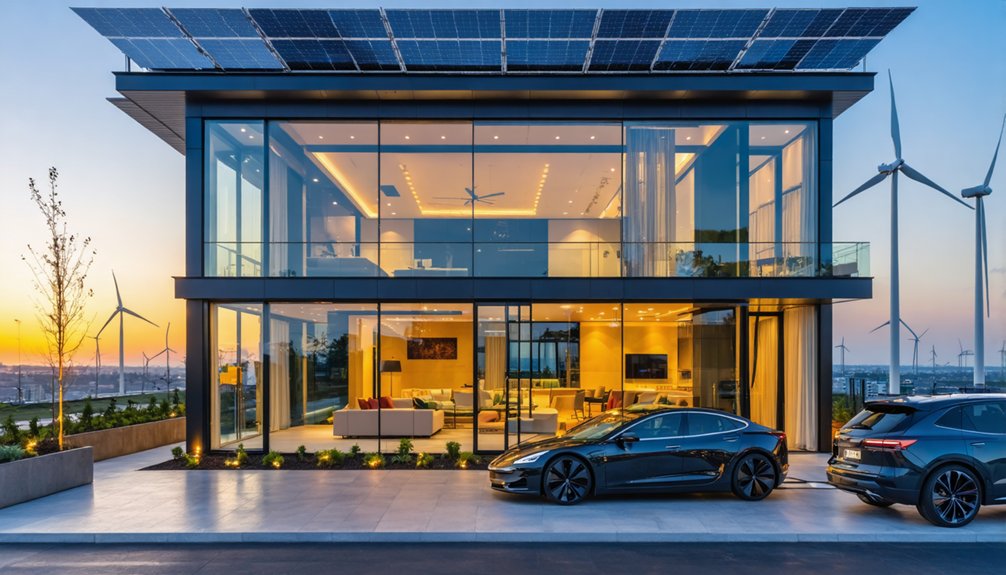

Green technology reduces energy usage by improving efficiency at every stage of supply and demand. In 57% of establishments, energy efficiency rises after adoption, and smart controls can cut waste by up to 20% while lowering peak demand 25%. Solar and wind avoid the energy costs of fuel extraction and combustion, with lifecycle emissions far below coal. Batteries, DERs, and smart grids shift power to when it is needed most. The sections below explain where these savings grow fastest.
How Green Technology Cuts Energy Waste
Because green technology improves how energy is produced, managed, and recovered, it plays a measurable role in cutting energy waste across operations. Evidence shows energy efficiency improves in 57% of establishments using green technologies, while the relationship with lower energy use is strong overall, with beta 0.480 and t-value 12.897. In waste-to-energy systems, incineration dominance is especially notable, accounting for 78.66% of the market in 2023. These systems also sit above disposal in the waste hierarchy because energy recovery is preferred over landfilling.
These gains rarely stand alone: 82% of establishments pair efficiency technologies with other practices, creating a shared system of smarter performance.
Waste reduction strengthens these results. Green technology’s effect on waste reduction is significant, with a 0.623 path coefficient, and 70% of efficiency-focused users also cut waste. However, without federal recycling policy, the U.S. still faces major barriers to properly handling solar panels, EV batteries, and wind turbine blades.
Through circular recycling, resource recovery, and demand‑response coordination, organizations reduce unnecessary energy inputs, avoid landfill-related losses, and reinforce sustainability outcomes that members, workers, and communities can support together confidently.
Why Solar and Wind Need Less Energy
Why do solar and wind need less energy overall? They generate electricity directly from ambient flows rather than from mined fuels that require extraction, transport, and combustion. This gives both technologies a smaller energy resource footprint across production. Both produce zero emissions during operation, helping reduce dependence on fossil fuels.
Modern wind turbines capture about 50% of passing energy, with capacity factors near 30-45% onshore and up to 35-50% at utility scale. Solar panels convert roughly 15-22% of sunlight, while leading systems reach 22-23%. Wind turbines can convert as much as 60-90% efficiency under optimal conditions. Wind also has a lower lifecycle CO2 footprint per kWh than solar panels.
Continuous innovation strengthens this advantage. Bifacial panels can collect 30% more reflected light, and AI tracking can lift solar output by 25%. Perovskite gains also improve conversion beyond older silicon designs.
Lower resource footprint and low lifecycle emissions follow: wind produces about 4-34 grams CO2 per kWh, solar 6-50, far below coal’s roughly 1,000 grams per kWh globally.
How Batteries Reduce Wasted Power
How do batteries reduce wasted power in modern energy systems? They capture surplus electricity that would otherwise be curtailed and return it during periods of higher demand.
In practice, battery energy storage shifts renewable output to useful hours, lowering avoidable losses across homes, vehicles, and industry. Most utility-scale systems today are built for 1-4 h duration, which makes them best suited to short-term shifting rather than extended backup.
Batteries also reduce waste by making intermittent wind and solar more usable through renewable storage.
Manufacturer round-trip efficiency can exceed 85%, while field performance is closer to 70% after inverter losses, thermal management, and auxiliary loads.
Even with these real-world losses, batteries reduce total waste by replacing inefficient fossil peaking and by supporting local self-consumption. In EV-linked storage and transport systems, limiting frequent high-power charging helps preserve battery health because DC fast charging is the main driver of accelerated degradation.
Household solar-battery systems can cut grid demand by up to 38%.
Costs have fallen 97% since 1991, expanding access and shared participation.
Performance depends on careful charging, because high-power operation accelerates thermal degradation and shortens capacity retention over time for communities.
How Smart Grids Lower Energy Usage
While conventional grids react after demand changes, smart grids lower energy usage by continuously measuring load conditions and adjusting generation, voltage, and routing in real time. Smart meters, intelligent appliances, and AI forecasting align supply with actual demand, reducing waste by up to 20% and lowering peak demand by 25%. Juniper Research projects global smart-grid cost savings will exceed $125 billion by 2027, highlighting the scale of cost savings these systems can deliver.
Advanced analytics strengthen grid meter optimization by processing meter, network, and weather data for scheduling, fault diagnosis, and predictive maintenance. These controls reduce transmission losses by up to 30% through voltage management and efficient rerouting, contributing to a 12% direct reduction in electricity-sector energy use and emissions. Grid resilience studies also show that balanced loads support renewable integration, trim customer costs by 10 to 15%, and help communities participate in a more reliable, lower-carbon energy system together nationwide.
Why Efficiency Beats Building More Supply
Because efficiency cuts demand before new generation or wires are needed, it usually delivers the cheapest and fastest path to a more capable energy system. Evidence shows demand side measures can expand effective grid capacity at roughly half the cost of supply projects and deploy 5 to 10 times faster.
That advantage strengthens as grid‑optimization tools scale. Reconductoring, adaptive line rating, topology optimization, and storage as transmission relieve congestion without waiting years for conventional buildouts.
High‑efficiency motors already save more electricity globally than data centers consume, while distributed resources meet peaks affordably. Falling clean technology costs reinforce the case: solar power is down 89% since 2010, and storage costs have more than halved. With policy‑incentives and demand‑efficiency, communities gain reliable, lower‑cost energy progress together.
How Green Technology Shrinks Fossil Fuel Demand
As green technologies scale, they displace fossil fuel demand by supplying new electricity needs faster than coal and gas can retain market share.
Globally, solar generation rose 31% and wind 7.7% in the first half, adding more than 400 terawatt hours, enough to exceed electricity demand growth.
Renewables surpassed coal generation worldwide for the first time, while fossil output slipped below 1%.
This shift is reinforced by policy, policy incentives, and carbon accounting that increasingly reward lower-emission supply.
China and India both expanded solar and wind fast enough to reduce fossil generation and emissions.
Investment signals are aligned: $2.2 trillion flowed to clean energy in 2025, and over 90% of new power capacity came from renewables.
Communities following these trends can see a durable, measurable energy change underway.
Where Green Technology Is Cutting Energy Fastest
Momentum is concentrated in sectors where efficiency gains and electrification can be deployed fastest: data centers, homes, transport, utility-scale solar, and grid infrastructure.
In data centers, demand may exceed 2,200 TWh by 2030, so savings depend on grid digitalization, battery storage, DERs, and microgrids that optimize loads in real time.
In homes, demand-side measures add capacity at half the cost and up to ten times the speed of supply projects, reducing bills and waste.
Transport follows, with U.S. EV sales reaching 1.6 million in 2025.
Utility-scale solar added 27 GW AC in 2025, while costs have fallen 89% since 2010.
Across grids, reconductoring, adaptive line rating, and storage hybridization deliver faster integration, showing how green policy helps communities move together toward lower energy use.
References
- https://www.adopter.net/knowledge-hub/50-green-tech-statistics-you-need-to-know-in-2026
- https://rmi.org/the-energy-transition-in-2026-10-trends-to-watch/
- https://www.abiresearch.com/blog/renewable-energy-statistics
- https://bcse.org/market-trends/top-six-trends/
- https://www.wavestone.com/en/insight/anticipating-2026-trends-reshaping-energy-landscape/
- https://press.spglobal.com/2025-12-09-S-P-Global-Energy-Releases-Key-Clean-Energy-Trends-for-2026-as-AI-Growth-and-Geopolitical-Shifts-Reshape-Global-Energy-Markets
- https://www.weforum.org/stories/2025/12/global-energy-2026-growth-resilience-and-competition/
- https://www.unsdsn.org/news/powering-a-green-energy-future-for-2026-and-beyond/
- https://pmc.ncbi.nlm.nih.gov/articles/PMC10709062/
- https://www.bls.gov/opub/btn/volume-2/pdf/reduce-reuse-recycle-green-technologies-and-practices-at-work.pdf